A Structured Process Built for Modular Delivery
Modular construction requires a fundamentally different project management framework — one that accounts for parallel factory production and field execution simultaneously. Our advisory approach is built around that reality: a four-phase process that integrates design alignment, manufacturing oversight, logistics coordination, and on-site installation support into a single, coherent workflow.
Each phase is structured to eliminate the gaps that typically emerge between the off-site and on-site tracks — missed design coordination, misaligned delivery schedules, inadequate site staging, and reactive quality control. We bring the factory and the field into the same decision loop, from the earliest preconstruction conversations through the final module set.

PHASE 01
Preconstruction & Planning
Before a single module is manufactured, the decisions made during preconstruction determine whether a modular project delivers on its schedule and cost promises. We engage early — at schematic design or earlier — to establish the foundational framework that every downstream phase depends on.
What we deliver in this phase:
- Constructability review of early design documents for modular-specific buildability
- Risk identification across design, regulatory, and manufacturing dimensions
- Design alignment between architect, manufacturer, and site team
- Schedule framework development with integrated factory and field milestones
- Module matrix development: counts, configurations, and stacking strategy
Entering preconstruction without modular-specific expertise means discovering conflicts late — in the factory or on-site — when corrections are expensive and schedule impacts are unavoidable. Early advisory engagement is where the project's margin is protected.


PHASE 02
Design & Manufacturing Coordination
Once production begins, the single greatest source of modular project delay is misalignment between what design teams specify, what manufacturers produce, and what site conditions require. We manage the coordination layer between all three — continuously, not episodically.
Coordination scope includes:
- Ongoing design-to-manufacturing review for dimensional, structural, and MEP conflicts
- RFI and submittal tracking across manufacturer, architect, and engineer of record
- Factory production milestone tracking against the master project schedule
- Finish and specification alignment to prevent field rework after module delivery
- Change order impact analysis for design modifications during production
Production conflicts discovered after modules leave the factory are among the most expensive problems in modular construction. Our coordination role is specifically structured to catch and resolve those conflicts before they become field problems.
PHASE 03
Logistics & Sequencing
Module delivery is a precision operation. Transport routes, crane picks, site staging areas, and delivery sequences must all be engineered together — not managed reactively on the day trucks arrive. We develop and manage the full logistics plan as a core project document.
Logistics planning covers:
- Transport route analysis: permit requirements, clearances, and carrier coordination
- Delivery schedule sequencing aligned to installation sequence and site readiness
- Crane and rigging strategy: reach, capacity, and mobilization planning
- Site staging layout: laydown zones, access paths, and temporary works coordination
- Weather, traffic, and site access contingency planning
A failed delivery day — a blocked route, an undersized crane, a staging area that isn't ready — erases days or weeks of schedule. Our logistics planning converts that risk into a documented, coordinated plan with clear accountability.

PHASE 04
Installation & Quality Control
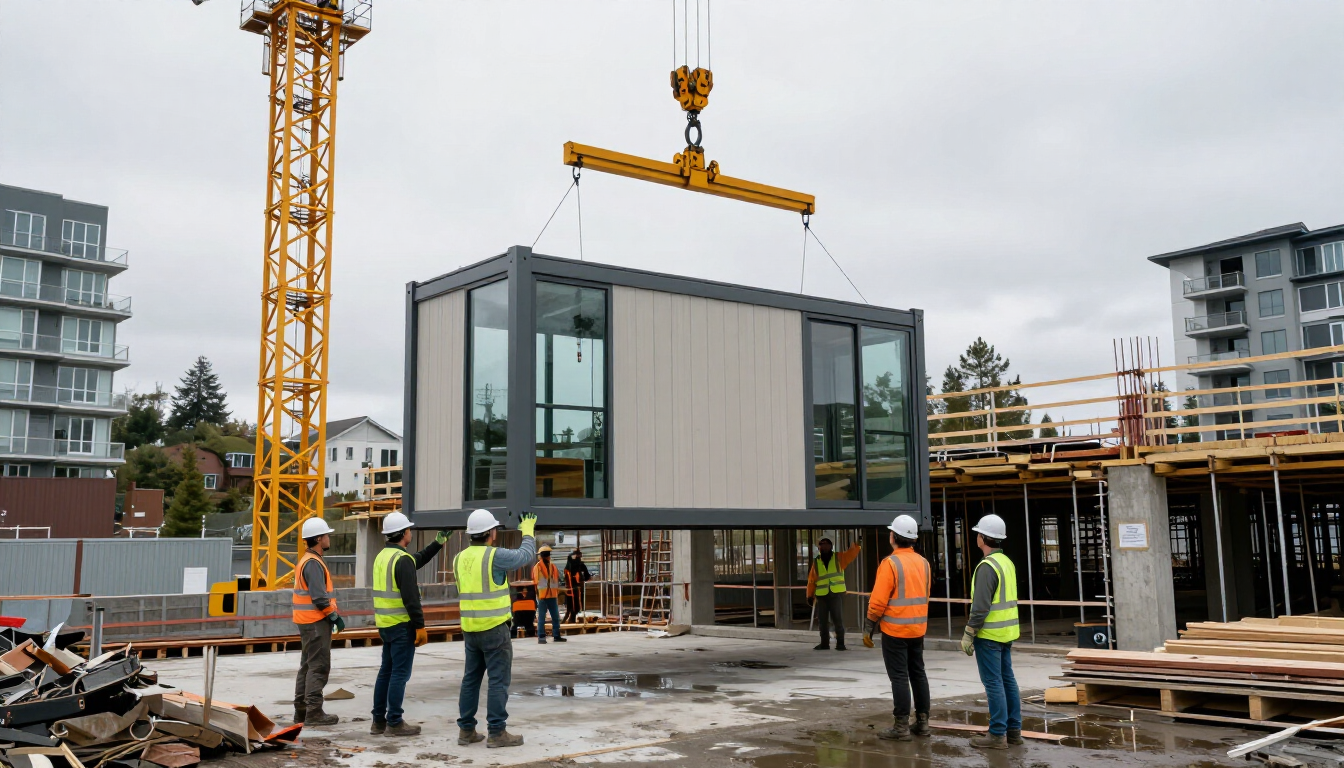
Installation day is the culmination of every upstream decision. Our role on-site is to ensure that what was planned — the sequence, the tolerances, the connection details — is what actually happens. We provide active oversight, not passive inspection.
Installation oversight includes:
- On-site presence during module set operations to manage sequence and coordination
- Real-time quality verification against approved submittals and specifications
- Connection and interface inspection: structural, MEP, and envelope tie-ins
- Issue identification and resolution with contractor and manufacturer teams
- Progress documentation and deviation reporting for owner and project record
Modules that are set incorrectly or out of sequence create compounding problems — structural corrections, MEP rework, and schedule overruns that negate the efficiency advantage modular construction is supposed to deliver. Disciplined installation oversight is how that advantage is protected through to project completion.
Factory-to-Field: The Core of Our Advisory Model
Most construction advisors operate on one side of the modular divide — either they understand manufacturing or they understand field construction. We operate across both. Our factory-to-field coordination model manages the off-site production track and the on-site installation track as a single integrated workflow, with one advisory team holding the complete picture.
That integration is what prevents the most common and costly modular project failures: design conflicts discovered in the factory, delivery sequences that don't match installation readiness, and quality issues that surface only after modules are set. When both tracks report to the same advisory layer, those gaps close — and the schedule and cost advantages of modular construction are actually realized.
Common Questions About Our Approach
Every project team comes to modular advisory with different structures, scales, and delivery methods. Here are the questions we hear most often about how our process fits.
Does your approach work for smaller projects or first-time modular developers?
Yes. Our phased approach scales to project size. For smaller or first-time projects, we often focus engagement on the phases where modular-specific expertise matters most — typically preconstruction and logistics — and provide lighter-touch coordination support across the rest. We adapt scope to the project's actual risk profile, not a fixed service package.
Can you work alongside an existing GC or project management team?
That is our most common engagement model. We integrate into existing project teams as the modular-specific advisory layer — working alongside the GC, owner's rep, or CM without duplicating their roles. Our value is the factory-to-field expertise that most generalist project teams don't carry internally.
What if our project uses a design-build or developer-led delivery method?
Our approach adapts to any delivery structure. In design-build or developer-led projects, we typically engage directly with the owner or developer and coordinate with the design-build team as the modular subject matter authority. The phases remain the same; the reporting relationships adjust to match the contract structure.
At what point in a project should we engage your firm?
The earlier, the better — and that's not a sales pitch. The decisions made at schematic design and in manufacturer selection have more impact on project outcomes than anything that happens later. Ideally, we engage at the feasibility or early schematic stage. That said, we can add meaningful value at any phase, including projects already in production or approaching installation.
How do you handle projects in markets or jurisdictions where you haven't worked before?
Modular construction principles are consistent across markets; regulatory and logistics conditions vary. For new markets, we conduct jurisdiction-specific due diligence as part of preconstruction — covering third-party inspection protocols, transport permit requirements, and any state or local modular approval pathways — and we engage local specialists where that adds value.
Thank you — we'll be in touch shortly to schedule your consultation.
Let's Map Your Project to a Process
Whether you're entering preconstruction on a new modular multifamily development or navigating a project already in production, our advisory approach is designed to integrate with your team and your schedule.
Schedule a consultation to walk through how our four-phase process applies to your specific project — its scale, delivery method, and current stage.